From Financial Documents to Financial Intelligence: The Next AI Opportunity for Banks and NBFCs
Why the real challenge in financial services is no longer reading information, but connecting, validating and using it.
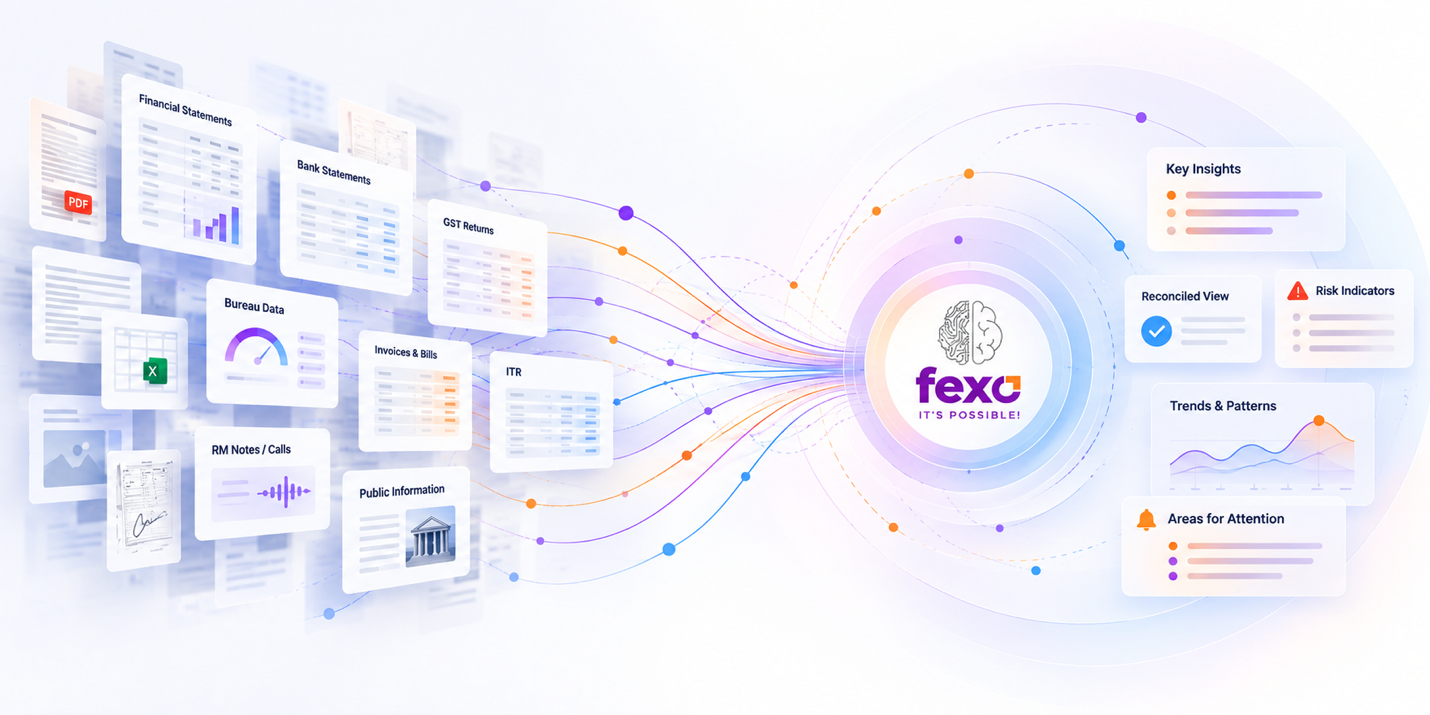
Financial institutions have never lacked information.
A typical business lending decision can involve audited financial statements, bank statements, GST returns, income-tax records, bureau reports, application data, management information, relationship-manager inputs and external information. An audit or insurance claim can involve an equally diverse collection of reports, invoices, forms, images, correspondence and supporting evidence.
The problem is that this information rarely arrives as one coherent dataset. It arrives fragmented across documents, systems, formats and sources.
For decades, financial institutions have invested in digitising this information. OCR made documents machine-readable. Intelligent Document Processing made extraction more flexible. APIs made structured data easier to access. More recently, Large Language Models and multimodal AI have dramatically improved a machine's ability to understand documents.
These are important advances. But after two years of building AI solutions with financial institutions, we believe they expose a more fundamental problem:
Reading the information is only the first step. The real value comes from connecting it.
That distinction may define the next phase of AI in financial services.
What is fragmented financial information?
Fragmented financial information is information about the same customer, transaction, asset or event that exists across multiple documents, data sources and formats, but must be brought together before it can support a decision.
Consider a business seeking credit.
Its audited financial statements may tell a lender what the business reported for the financial year. Bank statements reveal actual movement of money. GST data provides another view of business activity. Bureau information describes existing credit relationships and repayment behaviour. Management conversations provide context that may not appear in any structured source.
Individually, each source tells part of the story. The credit analyst's job is not simply to read each one. The analyst has to determine whether the stories told by these sources are consistent with each other.
That is a very different computational problem from document extraction.
And the same pattern appears elsewhere in financial services. An insurance claim may require an insurer to reconcile a claim form with an FIR, invoices, photographs, surveyor reports and policy information. An audit may require information to be traced across financial statements, tax records, transaction documents and supporting evidence. A secured-lending transaction may require information about a borrower, asset, ownership, valuation and legal documentation to be considered together.
Important financial decisions depend on connecting information that was never designed to work together.
Why digitisation alone does not solve the problem
Much of financial-services automation has historically concentrated on converting documents into data. That was necessary. A number trapped inside a scanned financial statement cannot easily participate in an automated workflow. Extracting that number into a structured field makes computation possible.
But extraction answers only one question: What does this document say?
Financial decision-making requires several more:
- What does another source say about the same thing?
- Do the two agree?
- If they do not agree, is the difference explainable?
- Has something changed materially over time?
- Is there an unusual pattern that deserves investigation?
- What evidence supports the conclusion?
- What should the person reviewing the case pay attention to?
These questions move the problem from document processing towards financial intelligence.
The intelligence lies between the documents
Imagine a lender analysing a business. Extracting revenue from its financial statements is useful. But an experienced credit analyst rarely stops there.
The analyst may compare reported revenue with GST information, examine whether banking activity appears consistent with the stated scale of operations, assess movements in receivables and inventory, review leverage and repayment obligations, look for unusual transactions, compare multiple periods and investigate material inconsistencies.
No individual document contains that analysis. The intelligence emerges between the documents.
If AI is deployed merely as a faster document reader, institutions may automate a portion of today's manual work. If AI can reliably help connect, validate and interpret information across sources, a much larger part of the analytical workflow becomes addressable.
becomes
Evidence → Context → Analysis → Attention
That final word matters. The goal should not necessarily be to remove the human decision-maker. In many regulated financial workflows, human judgement remains critical.
A more useful objective is to ensure that skilled professionals spend less time finding, copying, reconciling and organising information — and more time evaluating what actually deserves judgement.
Five capabilities that turn financial information into intelligence
Moving from document automation to financial intelligence requires more than adding a general-purpose LLM to an existing workflow. In our experience, five capabilities become particularly important.
1. Understand heterogeneous information
Financial evidence can include native PDFs, scanned documents, spreadsheets, tables, images, handwritten information, voice inputs and structured data feeds. A useful system must understand these different forms without forcing every input into an artificially standardised format.
2. Establish context
A number without context is dangerous. ₹10 crore can represent revenue, debt, an invoice value, sanctioned limits or an outstanding balance. Financial intelligence requires understanding what a data point represents, which period it belongs to, which entity it concerns and how it relates to surrounding information.
3. Connect evidence across sources
Once information is understood, related evidence needs to be brought together. The objective is not simply aggregation. It is triangulation: comparing different representations of the same underlying economic reality and identifying where they reinforce — or contradict — one another.
4. Apply financial logic
Not every problem should be handed to a generative model. Ratios, reconciliations, thresholds, policy rules and many financial calculations require deterministic computation. Other tasks — understanding narrative disclosures, interpreting context or synthesising evidence — may benefit from AI reasoning. Reliable financial intelligence requires knowing where each approach belongs.
5. Preserve the path back to evidence
In financial services, an answer without evidence has limited value. A credit officer, auditor or claims professional must be able to ask: Why has this been flagged? Where did this number come from? What source supports this observation? Traceability therefore cannot be an afterthought.
What this changes for AI in banking and lending
The shift from document processing to financial intelligence changes how financial institutions should evaluate AI. Accuracy remains fundamental, but institutions should also ask whether it can work across multiple information sources, identify relationships between them, distinguish deterministic calculations from interpretative analysis, surface contradictions, trace observations back to evidence, and operate within institutional policies, processes and security requirements.
Does it reduce the amount of mechanical work required before a qualified person can exercise judgement?
That is a substantially higher bar than document digitisation. It is also where the potential business impact becomes much larger.
From faster processing to better use of human expertise
The most interesting ROI from AI in financial services may ultimately not come from the cost of reading a page. It may come from changing how expensive human expertise is deployed.
Consider a credit analyst spending several hours assembling information before meaningful analysis can begin. Reducing that preparation work changes more than turnaround time.
The same team can potentially process more cases. Experienced analysts can spend more time investigating exceptions. Credit decisions can begin with a more complete view of available evidence. Monitoring can move from periodic manual exercises towards more continuous identification of changes that warrant attention.
The same principle extends to audit, insurance and other information-intensive financial workflows. The scarce resource is often not information. It is expert attention. AI becomes valuable when it helps direct that attention to the right place.
Why financial intelligence is harder than generic GenAI
Applying generative AI inside regulated financial institutions is fundamentally different from building a general-purpose assistant. A plausible answer is not sufficient.
Financial workflows require consistency, traceability, security and the ability to reproduce deterministic outcomes where deterministic outcomes are required. They also involve institution-specific policies and definitions.
Two lenders can examine the same borrower while applying different credit policies, analytical templates or escalation rules. Two auditors may operate under different mandates. Different insurers can require different evidence for similar claims.
Financial intelligence therefore cannot simply mean asking a large model to “analyse these documents.” The system has to operate within the context of the financial institution and the workflow in which a decision is being made. That is where much of the difficult engineering begins.
The next phase: from reading to reasoning across evidence
Over the past two years at Fexo, our own view of the problem has evolved. We began by asking how machines could reliably understand complex financial documents.
Working with banks, NBFCs, insurers and audit teams led us to a broader question: Once the information has been understood, how can machines help financial professionals use it?
That question now guides much of our work.
At Fexo, we are building AI for document-intensive workflows across banking and lending, insurance, audit and other regulated financial processes. The objective is not merely to extract more fields or generate more text.
It is to help institutions move from fragmented evidence towards information that can actually support action — while retaining the controls, traceability and security that regulated workflows demand.
We believe this transition — from reading financial information to reasoning across financial evidence — will be one of the more consequential applications of AI in financial services.
Because financial institutions already have enormous amounts of data. The next opportunity is making that information work together.
Ready to explore what this could mean for your workflow?
If your teams spend significant time reading, reconciling and analysing information across financial statements, bank statements, GST data, reports, invoices, claims documents or other fragmented sources, we would be interested in understanding the workflow.
Request a personalised demonstration