AI Decisioning for Regulated Entities.
Unlocking Growth.
Triangulate. Adjudicate. Execute – with Agentic AI.
10x faster decisions. Zero Headcount Growth.
Case Processed
Auto-Analyzed & Verified
Recognized by Forbes India Top 100 Startups 2025 & Trusted By








-
0
BFSI AI Agents
-
0
Artifacts Processed
-
0
Hours Saved
*Artifacts = Documents, Images, Scans, Voice and other multi-modal data
Automate Multimodal Workflows. Accelerate Decisions. Multiply Impact.
Our clients see measurable real-world immediate ROI, not
theoretical "AI benefits".
We transform operational efficiency into a powerful engine for
business growth.
Processing Capacity
Handle surge volumes effortlessly. Scale your first-mile engagements and grow revenue without increasing headcount.
Productivity Increase
Free your experts from manual review. Eliminate data entry grunt work so they can focus on high-value analysis.
Auditable with Zero Backlog
Eliminate manual queues while maintaining a complete, compliant, and traceable audit trail for every decision.
One Product. Purpose-Built for Banking, Insurance and Audits.
Delivering BFSI-grade accuracy, reliability and scale for your most critical doc-intensive workflows.
Banking & Lending
End-to-end automation of Wholesale and SME lending doc-processes – from analysis to Credit Assessment Memos – for faster, safer lending decisions.
-
MCA & complex non-MCA financial statements (quant & qual analytics)
-
Triangulated business insights (statements, ITRs, voice)
-
External risk monitoring & industry analysis
Insurance
Automate manual processing and reduce human errors, fast-tracking claim responses by 10x for quicker, more accurate settlements.
-
Handwritten & vernacular document AI (FIRs, claim forms, invoices)
-
Cross-document triangulation & authenticity checks
-
Automated claim summaries for STP* & mismatch alerts
Audit & Compliance
Automate complex public sector and enterprise audits, from ITRs to land deeds, to minimize risk and save 100s of hours of manual work.
-
Public Sector Annual Report audits (IndAS compliance)
-
Multi-year audit of ITRs and financial documents of Enterprises
-
Audit of vernacular sale deed transaction documents
*STP: Straight Through Processing
Experience the Fexo Agentic AI, Instantly
Select a BFSI use case to see how our AI executes complex, unstructured workflow in seconds.
Sample Document
23 pages of blurred financial statement. Read through the pages to pull out the excerpts below on which analysis was done. 50 pages of images read to triangulate insights across them for faster claims processing. 321 pages of annual report including auditor report. Read through the complex tables including notes and cross references to generate the output.
Co-pilot Analysis
Click "Analyze" to see the instant insights.
Key Insights:
*This is a simplified demo. The proprietary FexoLM provides deeper insights.
Want to test with your own use case?
For security reasons, we don't accept public uploads.
Book a secure, private Proof of Concept (PoC) →Any AI Can Read. FexoLM Executes. The Only Agentic AI Built for BFSI.
Generic AIs behave like a Swiss army knife – they summarize text but are prone to hallucination and blind to context. Fexo behaves like a precision scalpel. It cross-references multi-modal data to verify facts, detect fraud, provide auditor-grade reasoning, and executes complex workflows with zero human intervention.
-
Higher Accuracy
Achieve 95%+ accuracy on complex, unstructured documents, even in vernacular languages, handwritten notes, and low-quality scans.
-
Factual & Trustworthy
No AI hallucinations. FexoLM provides an evidence-based approach, citing the exact source for every insight it generates.
-
Dynamic & Agentic Workflows
Agentic AI workflow manager adapts to your unique logic, allowing for customization and scalability beyond rigid, pre-built rules.
-
Consistent & Reliable
FexoLM delivers reliable, deterministic outcomes in your required custom format, every time, even as your "dark data" and workflows evolve.
-
Faster Deployment
Pre-trained for BFSI & Audit. Go live in weeks (private cloud or on-prem) with pre-built APIs for seamless integration.
-
Bank-Grade Trust
Zero Data Egress. Built especially to meet security and compliance needs of global banks, auditors, and insurers.

Enterprise-Grade Security
We are built for the enterprise. ISO/IEC 27001:2022 Certified for Information Security Management Systems (ISMS), ensuring your data is always protected by enterprise-grade security.

Available on Google Cloud Marketplace
As an official Google Cloud Partner, our solution is trusted and available on the Google Marketplace. This accelerates procurement and allows Google's sales teams to bring Fexo directly to you.
Our Technology Partners
We partner with the best to build the most powerful, scalable, and secure AI.





Latest Thinking on AI & Finance
Deep dives into agentic AI, regulatory compliance, and the future of automation in BFSI.

A History of Intelligent Document Processing
Trace the brutal history of document automation–from paper to brittle OCR to slow IDP. Discover the Fexo AI-First approach that delivers instant intelligence.

The Credit Workflow Dilemma: Where Hardcoding Fails
Discover why hardcoded logic fails in modern lending and how Dynamic AI Workflows eliminate the IT bottleneck.

The Power of Customizable Workflows in Invoice Processing
Discover how FexoLM’s customizable workflows streamline accounts payable, ensuring compliance and efficiency through tailored routing and integration.
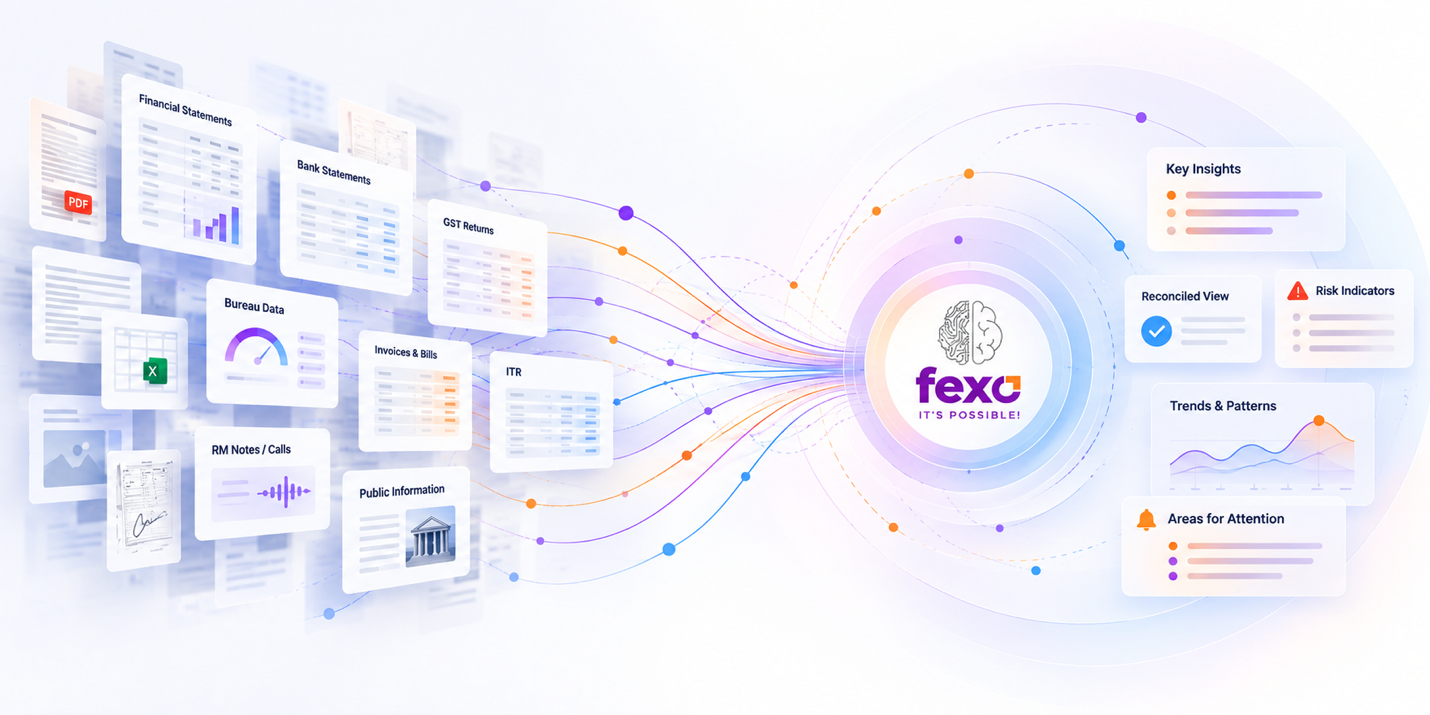
From Financial Documents to Financial Intelligence
Why the next AI opportunity for banks and NBFCs lies in connecting, validating, and using fragmented financial data.
Ready to 10x Your Business Velocity?
Don't let paperwork define your speed limit. Fexo’s Intelligent Agents turn complex multi-modal workflows into a competitive advantage – so you can scale without limits. Schedule a demo to reduce risk, accelerate growth, and unlock ROI from Day One.