Beyond CAM Generation: What Meaningful AI-Led Credit Appraisal Should Deliver
Why the future of commercial credit assessment lies in connecting financial evidence, interpreting risks and supporting better credit decisions – not simply producing reports faster.
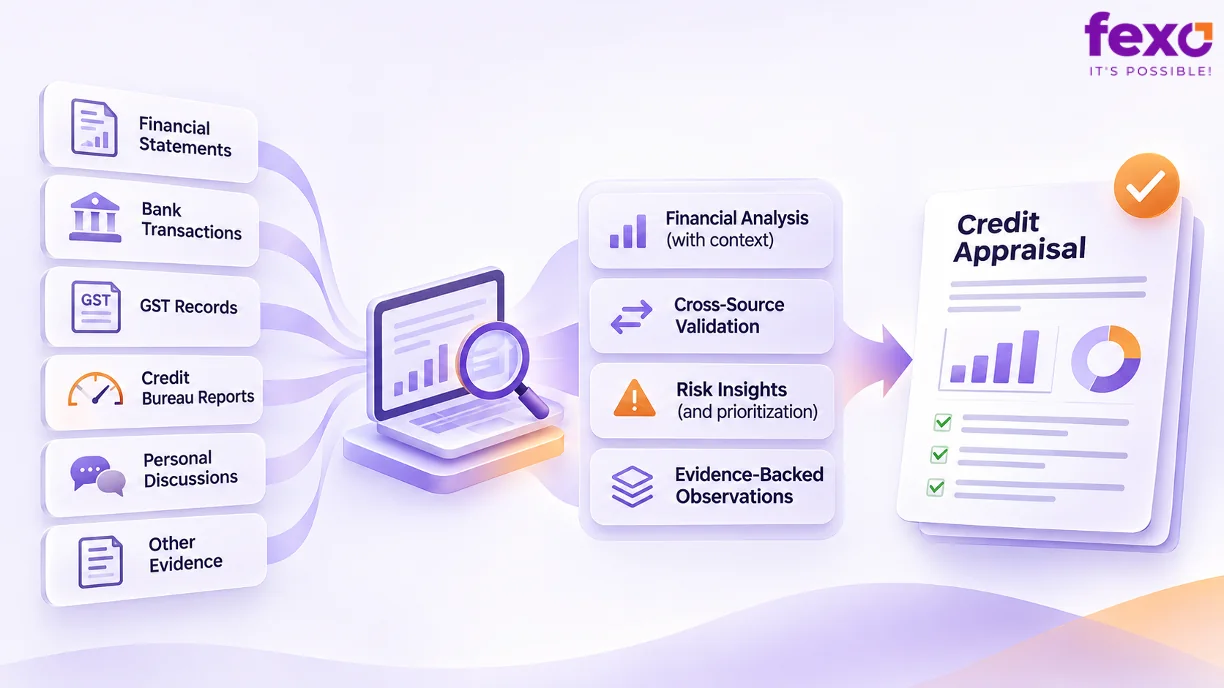
The Credit Appraisal Memo Is the Output. The Assessment Is the Real Work.
For banks and NBFCs, the Credit Appraisal Memo (CAM) is a critical document. It brings together financial analysis, borrower information, credit history, risk observations and the rationale supporting a lending decision.
As financial institutions explore AI-led automation, much of the discussion focuses on how quickly a CAM can be generated.
But there is an important distinction.
Generating a well-structured credit memo is not the same as performing a meaningful credit assessment.
A system may extract figures from financial statements, calculate ratios, populate predefined templates and generate narrative commentary. These capabilities can reduce manual effort substantially.
Yet the most valuable part of credit appraisal happens before the final document is produced.
It involves understanding the borrower's financial position, validating information across independent sources, identifying inconsistencies, interpreting risks and determining what deserves further investigation.
For MSME, SME and mid-market lending, where information can be fragmented, incomplete or inconsistently presented, this distinction becomes especially important.
The next opportunity for AI in commercial lending is therefore not merely faster CAM generation. It is deeper, more consistent and more efficient credit intelligence.
1. Credit Assessment Begins with Fragmented Information
A commercial credit assessment rarely relies on a single, complete source of information.
Credit teams typically work with a combination of:
- Financial statements, including schedules and notes to accounts
- Income tax returns and other statutory filings
- Bank statements and transaction histories
- GST returns and related tax information
- Credit bureau reports and existing borrowing obligations
- Stock statements and other operational records
- External credit ratings, where available
- Personal discussions with borrowers, promoters and relationship managers
- Other supporting documents and contextual information
Each source offers a different perspective on the borrower.
Financial statements describe reported performance and financial position. Bank transactions provide evidence of cash movements and operating behaviour. GST records offer another perspective on business activity. Bureau reports reveal credit exposure and repayment history. Personal discussions help explain business circumstances, operational challenges and management decisions.
The difficulty is not simply reading these sources individually.
It is connecting them into a coherent understanding of the business.
This is where traditional document automation reaches its limits. Extracting information is useful, but credit appraisal requires evaluating how that information fits together.
2. Financial Analysis Must Go Beyond Ratios
Financial ratios are fundamental to credit appraisal.
Liquidity, leverage, profitability, working capital and debt-servicing indicators help analysts evaluate the financial health of a borrower.
However, a ratio is a starting point for analysis, not necessarily a conclusion.
Consider a business reporting strong revenue growth.
On the surface, the trend appears positive. But a credit analyst may need to investigate several related questions:
- Is profitability improving alongside revenue?
- Are receivables growing faster than sales?
- Is the business generating operating cash flows?
- Has working capital borrowing increased disproportionately?
- Are margins under pressure despite higher turnover?
A company can report rising revenue while experiencing deteriorating liquidity or increasing dependence on external financing.
Similarly, an improving current ratio may not represent stronger liquidity if the underlying increase is concentrated in slow-moving inventory or overdue receivables.
Meaningful financial intelligence must therefore move beyond calculation to interpretation.
The objective is not to generate more ratios or longer commentary. It is to identify the relationships, trends and exceptions that help credit professionals understand the borrower's actual financial condition.
AI can assist by organizing financial evidence, highlighting material movements and generating contextual observations. Deterministic calculations remain essential for numerical consistency, while contextual analysis can help explain what the results may indicate.
Importantly, interpretations should remain open to analyst review and challenge.
3. Cross-Source Validation: Do the Numbers Tell the Same Story?
One of the most valuable aspects of commercial credit appraisal is the ability to compare information from different sources.
Consider three perspectives on business turnover:
- Financial statements: What revenue has the borrower reported?
- GST filings: What business activity is reflected in tax returns?
- Bank statements: What transaction patterns and receipts are visible in the banking records?
These figures will not necessarily match exactly.
Differences may arise from accounting treatment, timing, taxes, cash transactions, multiple banking relationships, non-operating receipts or other legitimate business circumstances.
The purpose of cross-source validation is therefore not to assume that every mismatch indicates a problem.
It is to identify differences, understand their possible causes and determine whether further investigation is warranted.
The same principle applies to other aspects of credit assessment.
Borrowings and repayment obligations
Do the liabilities reported in financial statements align with credit facilities and obligations reflected in bureau information?
Revenue and cash realization
Does reported business growth correspond with reasonable cash collections and banking activity?
Working capital and operating behaviour
Are changes in receivables, inventory and payables consistent with the borrower's reported operating performance?
Financial performance and management explanations
Do the explanations provided during borrower discussions reasonably support the trends observed in the underlying records?
Cross-source validation is particularly valuable because individual documents may be internally consistent while presenting an incomplete picture of the business.
The real insight often emerges from the relationships between sources.
4. From Data Exceptions to Meaningful Risk Insights
Credit appraisal is not simply about identifying anomalies.
It is about understanding which observations could materially affect the borrower's creditworthiness.
Consider a few examples.
Rising sales with weakening cash flows
This may warrant closer examination of collections, receivable quality or working capital requirements.
Increasing borrowing despite stable business activity
This could indicate higher financing dependence, changes in operating cycles or other factors requiring explanation.
Irregular repayment behaviour
Delays, overdue obligations or other bureau observations may provide useful context when assessing repayment discipline.
Unexplained variations across financial records
Differences between reported financial performance, tax filings and banking activity may deserve reconciliation before conclusions are drawn.
Not every exception is a risk, and not every risk can be established from the available data.
This distinction matters.
An effective AI-assisted credit assessment should distinguish between an observed fact, a calculated indicator, a potential risk and an issue requiring clarification.
For example:
- Observation: Receivables increased faster than revenue.
- Possible implication: Working capital may be under pressure.
- Further investigation: Examine ageing, collections and customer concentration.
Such structured interpretation is more useful than presenting a generic statement that the borrower has “working capital risk.”
The goal is to help analysts focus attention on the most material questions rather than overwhelm them with automated alerts.
5. Evidence-Backed Insights Are Essential for Trust
Credit appraisal operates in an environment where conclusions must be explainable.
A credit officer should be able to ask:
- Where did this number come from?
- Which document supports this observation?
- How was the ratio calculated?
- Why has the system identified this as a potential risk?
- Can the conclusion be challenged or revised?
These questions are fundamental to responsible AI adoption in lending.
A convincing narrative is not sufficient if the underlying evidence cannot be examined.
Meaningful automation should preserve traceability between source information, calculations, observations and the resulting credit commentary.
This becomes especially important when multiple datasets contain conflicting or incomplete information.
Rather than silently resolving every ambiguity, an AI system should be capable of highlighting uncertainty and identifying where human clarification is necessary.
Evidence traceability also supports internal review, auditability and more consistent credit processes.
In regulated financial environments, the ability to explain an insight can be nearly as important as the insight itself.
6. AI and Credit Professionals Have Different Responsibilities
The objective of AI-led credit appraisal should not be to remove human judgement from lending decisions.
Credit assessment involves considerations that extend beyond numerical analysis.
Industry conditions, promoter capability, business strategy, management credibility, market developments and institution-specific credit policies all influence the final assessment.
Some of these factors can be supported by structured evidence. Others require qualitative evaluation, professional experience and direct engagement with the borrower.
AI is well suited to handling substantial portions of the information-intensive work:
- Reading and organizing financial records
- Standardizing information across document formats
- Performing consistent financial calculations
- Comparing datasets and identifying exceptions
- Highlighting trends and potential risk indicators
- Preparing evidence-linked analytical commentary
Credit professionals remain responsible for validating the analysis, investigating exceptions, assessing qualitative factors, applying institutional policies and making or recommending lending decisions.
This division of responsibilities can improve both productivity and analytical depth.
When analysts spend less time assembling information, they can devote more attention to evaluating its implications.
The most useful AI systems are therefore not those that eliminate questions.
They are those that help credit professionals ask better questions.
7. What Should Banks Measure When Evaluating Credit Appraisal AI?
As banks and NBFCs evaluate AI solutions, the discussion should extend beyond how quickly a CAM can be produced.
A more meaningful evaluation considers several dimensions.
Analytical coverage
How much of the underlying financial and credit assessment can the system support, rather than merely populating the final template?
Cross-source consistency
Can it compare relevant information across financial statements, banking records, tax filings and credit bureau data?
Accuracy and traceability
Are calculations reliable, and can material observations be traced to their supporting evidence?
Risk relevance
Does the system surface meaningful exceptions and potential risks, or simply produce generic commentary?
Analyst control
Can credit professionals review, challenge, supplement and override the generated analysis?
Operational impact
Does the solution reduce preparation turnaround time, eliminate repetitive work and improve the number of cases teams can handle without compromising review quality?
Security and governance
Can the technology operate within the institution's required security, data-control and deployment framework?
These considerations help distinguish basic document-generation automation from a more comprehensive credit-intelligence capability.
The Bigger Opportunity: Better Credit Intelligence, Not Just Faster CAMs
Commercial lending remains information-intensive because the underlying decisions are complex.
A borrower cannot be understood through a single ratio, a single document or a well-written summary.
Meaningful credit appraisal requires bringing together multiple sources of evidence, understanding their relationships, identifying material risks and applying professional judgement.
AI offers an opportunity to make this process significantly more efficient.
But its value should not be measured solely by how quickly it produces the final Credit Appraisal Memo.
It should also be measured by the quality, consistency, traceability and usefulness of the analysis that precedes it.
At Fexo, this belief shapes our approach to private financial intelligence: helping financial institutions transform fragmented information into usable, evidence-backed insights while keeping credit professionals in control.
The future of credit appraisal is not simply about generating CAMs faster. It is about enabling lenders to make better-informed credit decisions, with greater analytical depth and operational capacity.
Fexo develops private financial intelligence solutions for banks, NBFCs and regulated institutions. Learn more at fexo.io.
Also read: From Financial Documents to Financial Intelligence